

The Office That Dreamed Too Loudly: Gaetano Pesce and the Chiat/Day Project
There's a particular kind of courage that lives in the space between vision and ridicule. It's the courage to make a floor out of resin so thick it had to be jackhammered out. To build desks that looked like they'd been dreamed by a fever. To tell a room full of advertising executives that their office should feel less like a place of business and more like the inside of someone's imagination. Gaetano Pesce had that kind of courage — the reckless, luminous, irreplaceable kind — and nearly two years after his passing, a new exhibition in Paris is asking us to look at one of his most daring acts all over again.
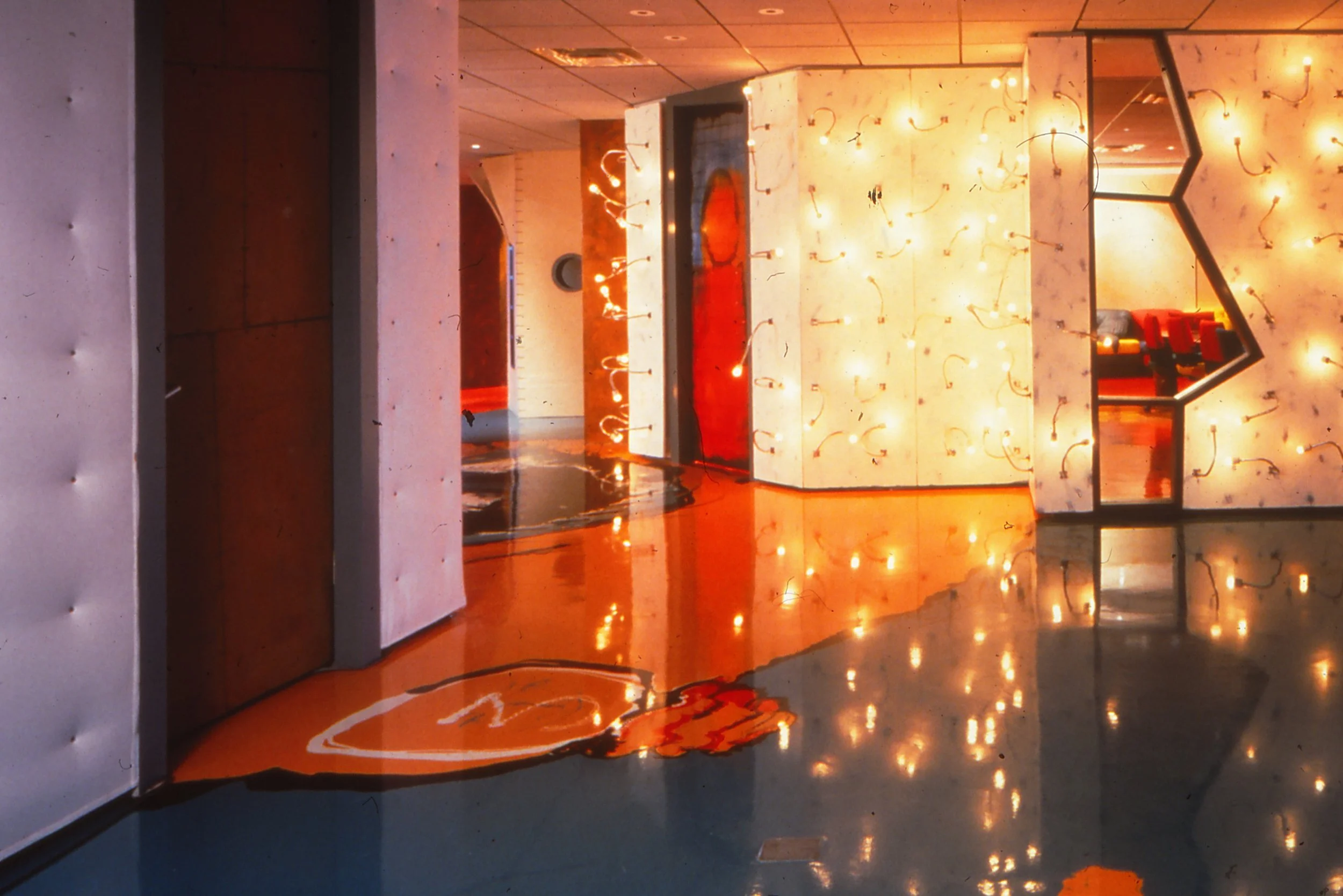
Pulp Galerie opened Gaetano Pesce: The Chiat/Day New York Project on March 26, running through April 25, and we can't stop thinking about it. The show resurrects one of the most radical workplace interiors ever conceived: the TBWA/Chiat/Day office that Pesce designed in 1994 for Manhattan's advertising elite. It was a space that rejected everything the corporate world held sacred — assigned seating, filing cabinets, the polite monotony of gray partitions — and replaced it with color, chaos, and an almost aggressive faith in the individual.
We think about this project the way we think about certain buildings in Austin that were torn down too soon, or certain meals we ate once and can still taste. The Chiat/Day office was dismantled within a few years of its creation. Labeled impractical. Too strange. Jackhammers were brought in to break up the resin floors. Furniture was scattered, lost, nearly forgotten. And yet here it is again, surfacing in a Parisian gallery like a message in a bottle from a future that the '90s weren't quite ready for.
The Assignment That Changed Everything
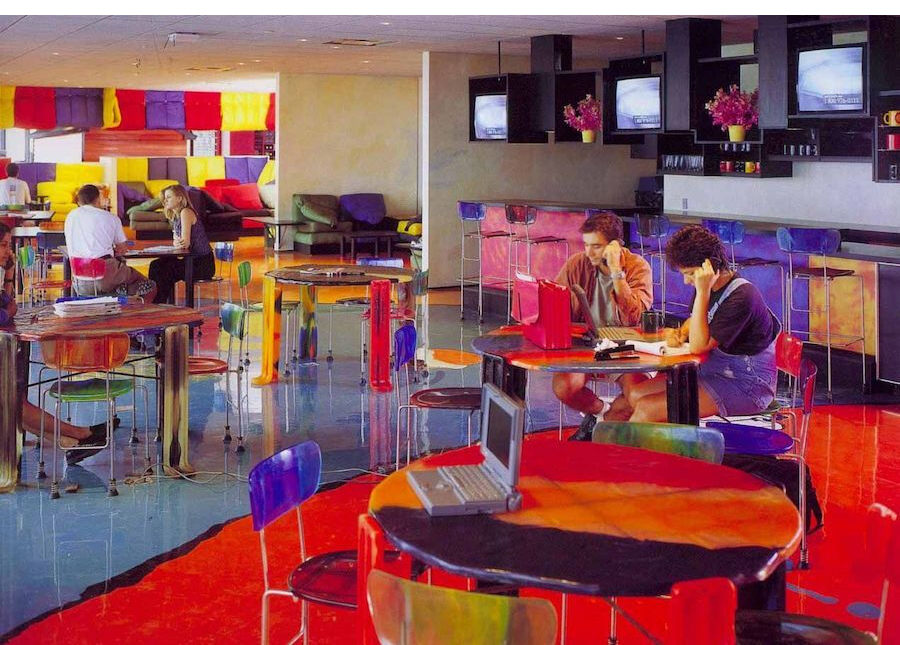
The story begins with Jay Chiat himself - the ad man who believed the office of the future would be paperless, deskless, and free. He gave Pesce what amounted to a dare: design a workspace where no one owns anything, where employees roam with their early-era laptops and log on wherever inspiration strikes. It was hot-desking before we had the word for it, remote-adjacent thinking in an era when "wireless" still felt like science fiction.
Pesce, characteristically, took the brief and detonated it. Rather than designing a sleek, minimalist sandbox for creative nomads, he built something that felt alive - almost biological. The floors were rivers of colored resin. The desks were translucent slabs embedded with metal grids, each one bearing its own fingerprint, its own texture, its own mood. Storage units refused to match. Communal furniture carried individual identities, as if each piece had a backstory and a temperament.
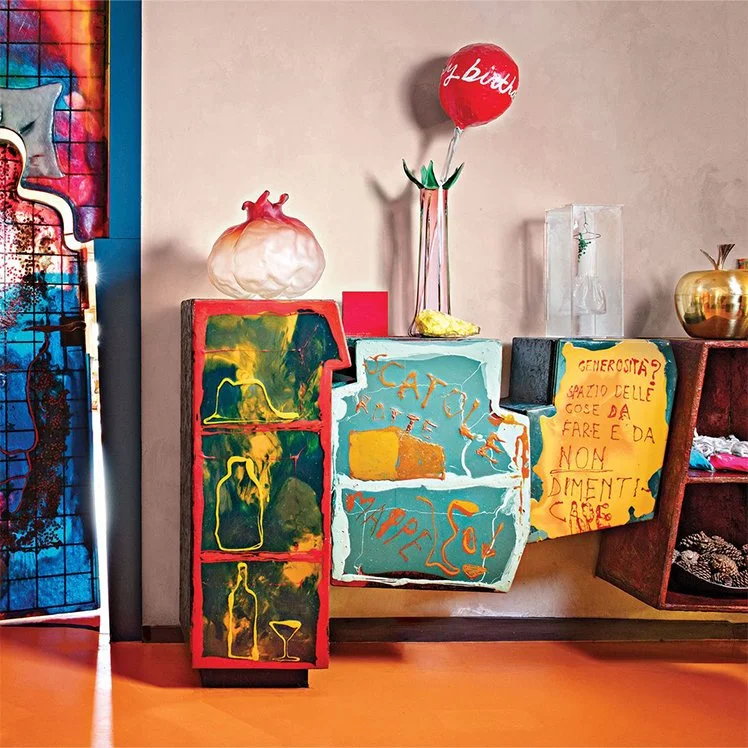
The lockers were perhaps the most tender detail. Each employee received a single wooden locker door — their only private territory in the entire office — and each door was rendered in psychedelic color with a face-shaped cutout. It was Pesce's quiet insistence that even in a space designed to dissolve hierarchy, personhood must remain. The face on your locker was your face, however abstracted. You existed here.
Why This Matters Now
We live in a moment obsessed with the question of how we work. The post-pandemic office debate has become a kind of cultural Rorschach test: are you a return-to-office person or a work-from-home person? Do you believe in the communal spark of shared space, or have you made peace with the kitchen table? Companies spend millions on "workplace experience" consultants. WeWork rose and fell and rose again. And through all of it, the fundamental question Pesce was asking thirty years ago remains unanswered: What does a workspace owe to the humans inside it?
His answer was: everything. The space should be as varied and unpredictable as the people who use it. It should refuse to be neutral. It should have opinions — about color, about form, about what a desk can be and what a floor can feel like underfoot. The Chiat/Day office wasn't designed to optimize productivity. It was designed to provoke aliveness.
And that's what makes this exhibition feel so urgent. In a design landscape increasingly dominated by algorithmic aesthetics — the same curved sofa in the same warm-toned living room on the same Instagram grid — Pesce's work is a reminder that design can be confrontational, personal, and deeply weird in the best possible way.
The Collector's Rescue
There's a detail in the Chiat/Day story that reads like a parable. When the office was demolished, many of its extraordinary pieces were headed for the landfill. A furniture collector stumbled upon a Broadway chair being sold on eBay in 1998 — listed by someone involved in the building's demolition. That failed bid set off a chain of rescue efforts that ultimately preserved fragments of Pesce's vision. Without those acts of recognition — someone seeing value where others saw debris — the exhibition at Pulp Galerie wouldn't exist.
We love this part of the story because it mirrors something we believe at Son of Rand: that curation is an act of devotion. Every object we choose to keep, display, or bring into our homes is a small declaration of what we think matters. The people who saved the Chiat/Day furniture understood that these weren't just desks and chairs. They were arguments. They were Pesce's way of saying, be careful — don't let the world flatten you into something convenient.
A New Publication
The exhibition arrives alongside a new book tracing the origins, context, and legacy of the Chiat/Day project, drawing from the archives of Studio Gaetano Pesce and accompanied by photographic documentation from Donatella Brun. For those of us who experience design through stories as much as through objects, this is the kind of publication that belongs on the shelf next to your most dog-eared monographs — a document of what happens when someone refuses to design a normal room.
The Pesce Frequency
Gaetano Pesce left us in April 2024 at eighty-four. In the years since, his work has only grown louder — exhibited at Design Miami, revisited in New York pop-ups, cited in every conversation about what contemporary design is missing. He belongs to that rare lineage of makers who treated every commission as a philosophical proposition. His UP chairs were about the oppression of women. His Nobody's Perfect chairs were about the beauty of imperfection. The Chiat/Day office was about the soul of labor.
We don't get many designers like this anymore. The industry has a way of smoothing out the edges, rewarding the marketable over the meaningful. But Pesce's work endures precisely because it resists that smoothing. It stays rough, colorful, opinionated, alive.
If you find yourself in Paris before April 25, go see this show. Stand in front of those resin desks and psychedelic lockers and let yourself feel something about the spaces where you spend your days. And if Paris isn't in the cards, let this be an invitation to look at your own workspace — your desk, your chair, the objects within arm's reach — and ask Pesce's question: Does this space know I'm here?
Gaetano Pesce: The Chiat/Day New York Project runs March 26 – April 25, 2026 at Pulp Galerie, Paris.
Explore our collection of objects that refuse to be ordinary at sonofrand.com.