

Object Lessons: The Chair Made of Air
Every object we love has a secret, and the Blow chair's secret is the best one in modern design: there is nothing inside. No frame, no foam, no springs, no wood. Just air — the most democratic material on earth — held in shape by welded seams of transparent PVC. Nearly sixty years after it first appeared, the chair made of air is suddenly everywhere again, and we think it has something to tell us about this exact moment.
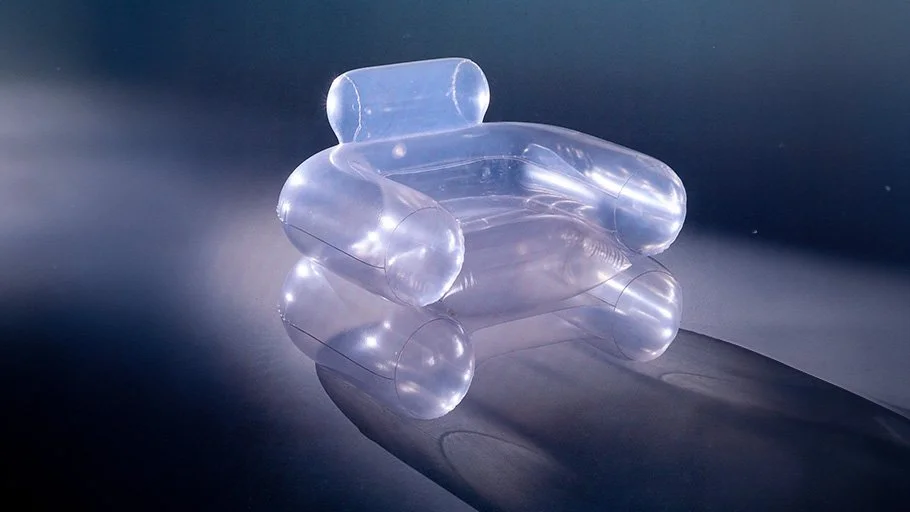
Blow Armchair by Zanotta
Milan, 1967
Picture Italy in the late sixties. The economic miracle has filled homes with proper furniture — walnut sideboards, upholstered suites, objects built to be inherited. Into this world of permanence, four young Milanese designers — Jonathan De Pas, Donato D'Urbino, Paolo Lomazzi, and Carla Scolari — release something closer to a provocation than a product: an armchair you inflate yourself, sold deflated with a foot pump and a repair kit, patched like a bicycle tire when it leaks.
The Blow chair, designed in 1967 and put into production by Zanotta the following year, became the first inflatable armchair to be mass-produced — a piece of radical design you could buy with pocket money and carry home under one arm. It was furniture as pop event: cheap, buoyant, faintly absurd, and gloriously unserious. You could float it in a swimming pool. Magazines photographed it obsessively. It anticipated a future in which living would be light, mobile, and unburdened by heirlooms.
And like all good provocations, it was polarizing. Critics saw disposability where its designers saw freedom. The plastic stuck to bare summer skin. It sagged. It punctured. None of that mattered, because the Blow chair was never really about sitting — it was about permission. Permission for design to be funny. Permission for a serious industry to make something that giggled.
The Long Deflation
Pop optimism has a shelf life, and by the mid-seventies the air had gone out — literally and culturally. The oil crisis made plastic suddenly expensive and morally suspect. Inflatable furniture retreated to dorm rooms and beach houses, resurfacing in the nineties as a nostalgic novelty in transparent neon, then vanishing again. The Blow chair itself ascended to the permanent collections of MoMA, the V&A, the Centre Pompidou and the Art Institute of Chicago — which is the design world's way of saying: important, but safely in the past.
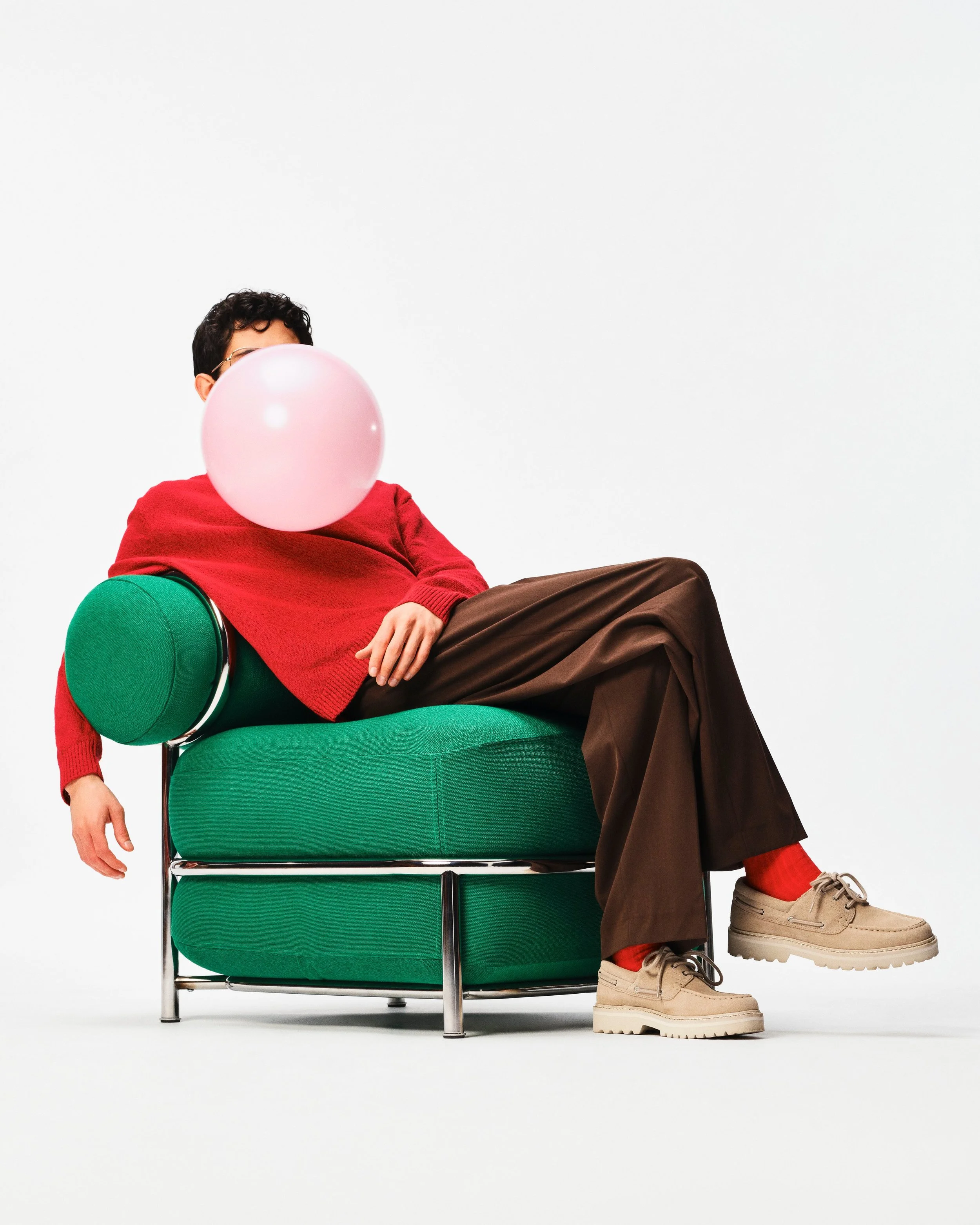
IKEA PS 2026 Easy Chair, designed by Mikael Axelsson — two inflatable cushions trapped in a bent carbon-steel frame. Image courtesy of Inter IKEA Systems B.V.
Except the past never stays put.
Milan, 2026
This April, visitors to Milan design week kept encountering a familiar sensation: the soft give of pressurized air. Dezeen named inflatables one of six defining trends of the fair — not as a wink of nostalgia, but as a full-blown material investigation, noting that blow-up furniture "truly ballooned this year, spotted everywhere from emerging designer shows to launches from big hitters like IKEA."
IKEA was the biggest of them. Its PS 2026 Easy Chair, designed in-house by Mikael Axelsson, traps two inflatable cushions inside a bent carbon-steel frame — a silhouette Dezeen likened to Marcel Breuer, collapsing a century of furniture history into one object. Axelsson's description of the process is almost a haiku of the whole trend: "Then we blew up a balloon and trapped it within that structure." London production designer Jabez Bartlett showed Inflatable Table 001 at Alcova — a low coffee table that reads as a giant PVC pillow beneath a milky, opalescent resin surface. Entire pavilions swelled and breathed. Even fashion joined in: Moncler draped a giant pink inflatable octopus, built by set designer Andy Hillman, across the façade of 10 Corso Como, tentacles spilling from the windows and rooftop.
Why now? We have a theory. Design has spent the past several years in a heavy mood — earnest, muted, tastefully burdened. Inflatables are the opposite of all of it: instant lightness, structure conjured out of nothing, form at its most honest (what you see is a skin and the air it holds — there is nowhere to hide a shortcut). In a moment when so much visual culture is generated, rendered, and endlessly smoothed, an inflatable object is almost defiantly physical. It responds to your weight. It moves when the air conditioning kicks on. It exists emphatically in the room with you.
There's a practical intelligence, too, that the 1967 original only hinted at. An object that ships flat and weighs nearly nothing is an object with a featherlight freight footprint. What once read as disposable now reads, strangely, as considered.
What the Chair Teaches
Object Lessons is our excuse to stare at one thing until it confesses, and here is the Blow chair's confession: joy is a legitimate design material. The chair endures not because it solved sitting — it didn't — but because it bottled a feeling. Six decades on, designers keep returning to that bottle whenever the culture needs to exhale.
You don't need an inflatable armchair to take the lesson home (though we'd respect it if you did). The lesson is about letting at least one object in every room be unserious — the piece that refuses to justify itself with function alone, that exists because it delights. The rooms we love most always have one. It's the object guests gravitate to, pick up, ask about. It's the exhale.

Ettore Sottsass at Poltronova, 1958–1974 — the Italian radical-design moment the Blow chair came out of. In the Son of Rand shop.
We keep a running list of objects that pass the Blow chair test — pieces with air in their spirit, if not in their construction. Many of them live in our shop, chosen for exactly that quality of built-in joy. Come see what's currently making us grin at sonofrand.com.